The Forum and Basilica
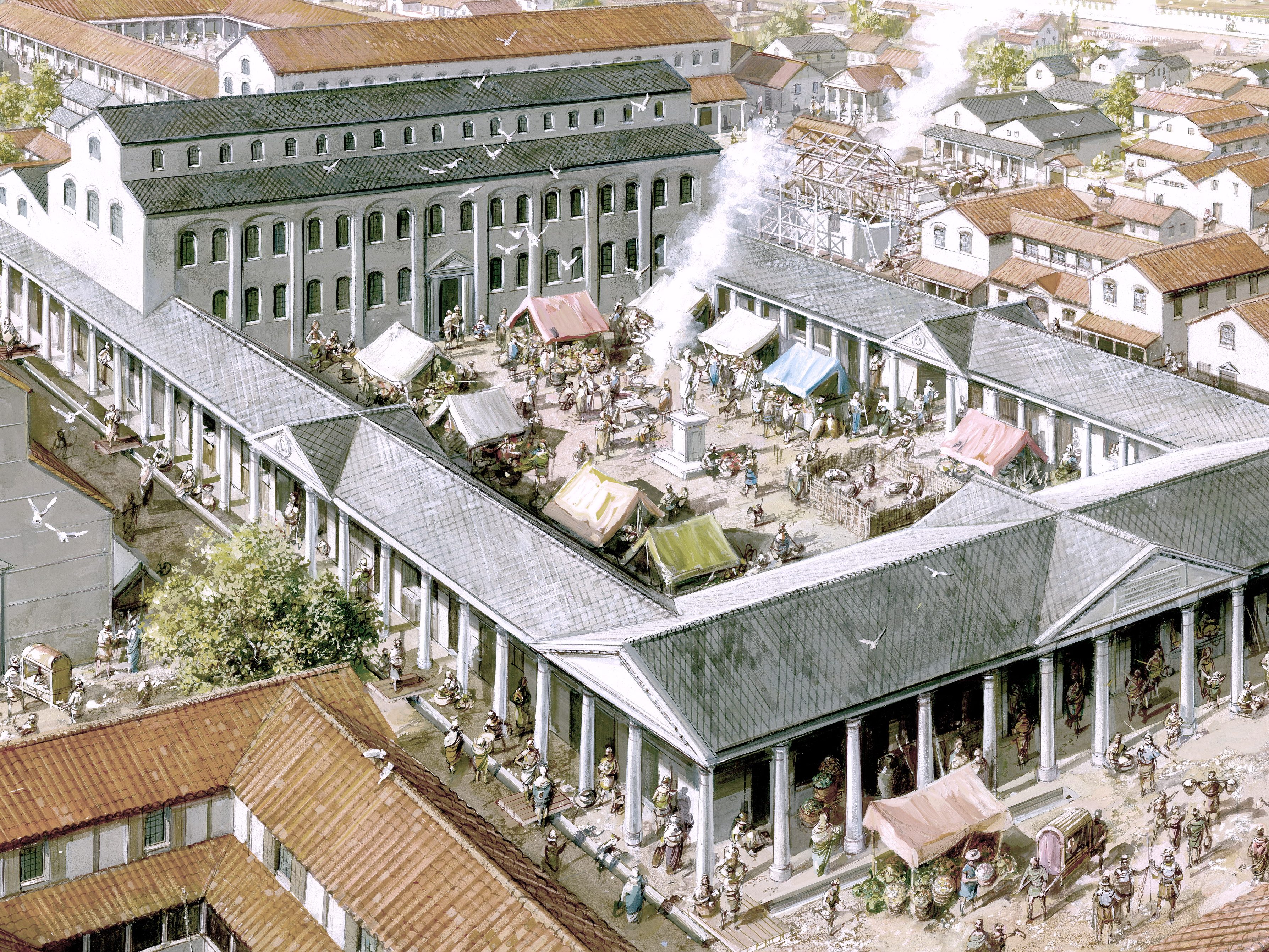
When Leicester’s street-grid was laid out in the early 2nd century AD, a large open area in the centre of the town was surfaced with gravel and set aside for the eventual construction of the main public buildings. These included the forum and basilica which functioned not only as a market-place but also as a centre for social, political and religious gatherings. Building the forum would have been a major undertaking in any Roman town and it would have taken perhaps fifty or sixty years to complete. Leicester’s adoption of the municipal trappings of urban life occurred much later than in many other Romano-British towns and the forum was probably not completed until the middle of the 2nd century AD.
The forum was a large open square surrounded on three sides by colonnades containing shops and enclosed on the fourth by the basilica, a large aisled building which housed offices and served as the town’s administrative and judicial centre. The main pedestrian access to the forum would have been via the south range, whilst wheeled traffic was probably admitted via a wider entrance in the east range. On completion the entire complex would have measured some 130m by 90m – larger than many football pitches.
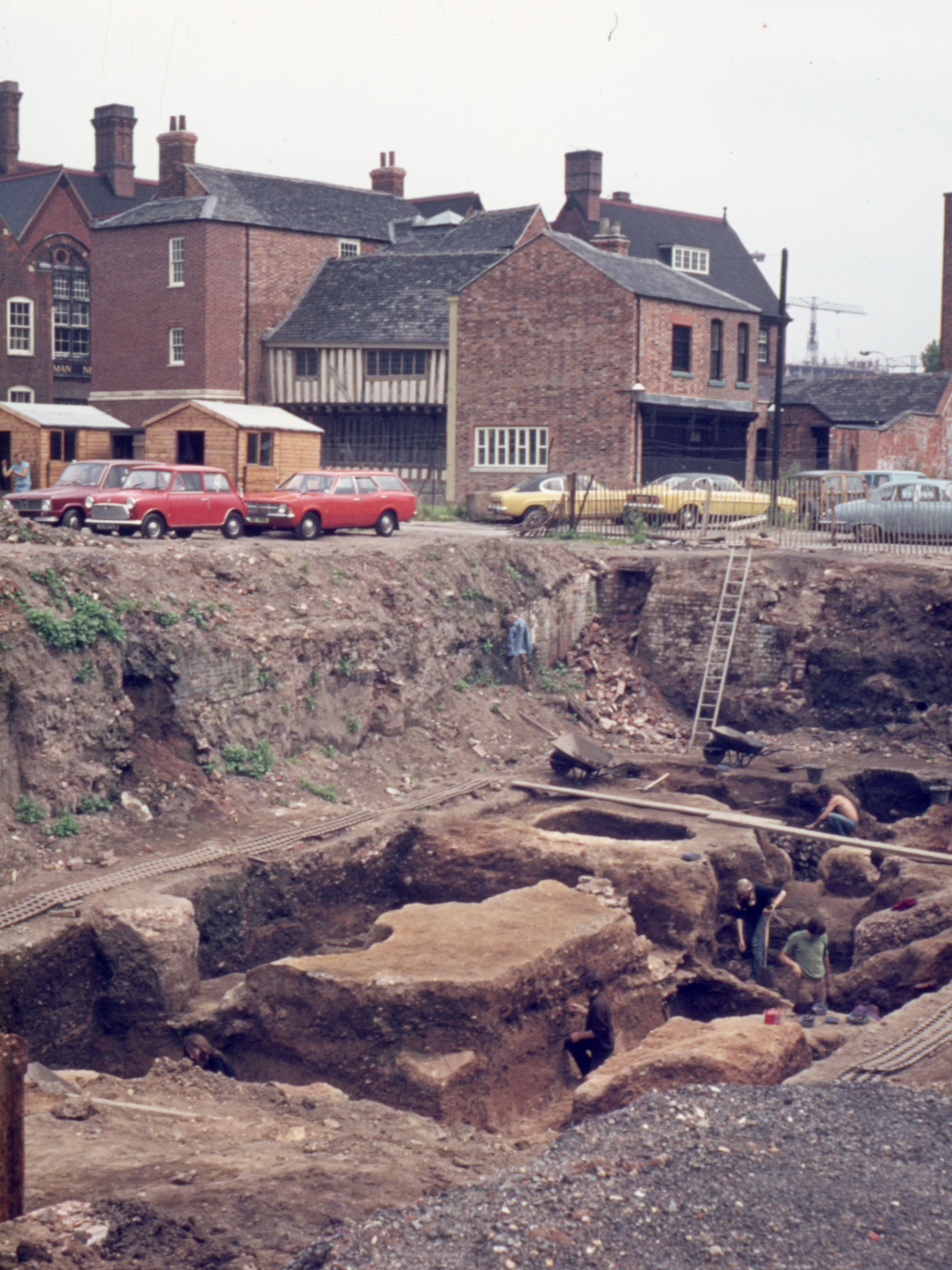

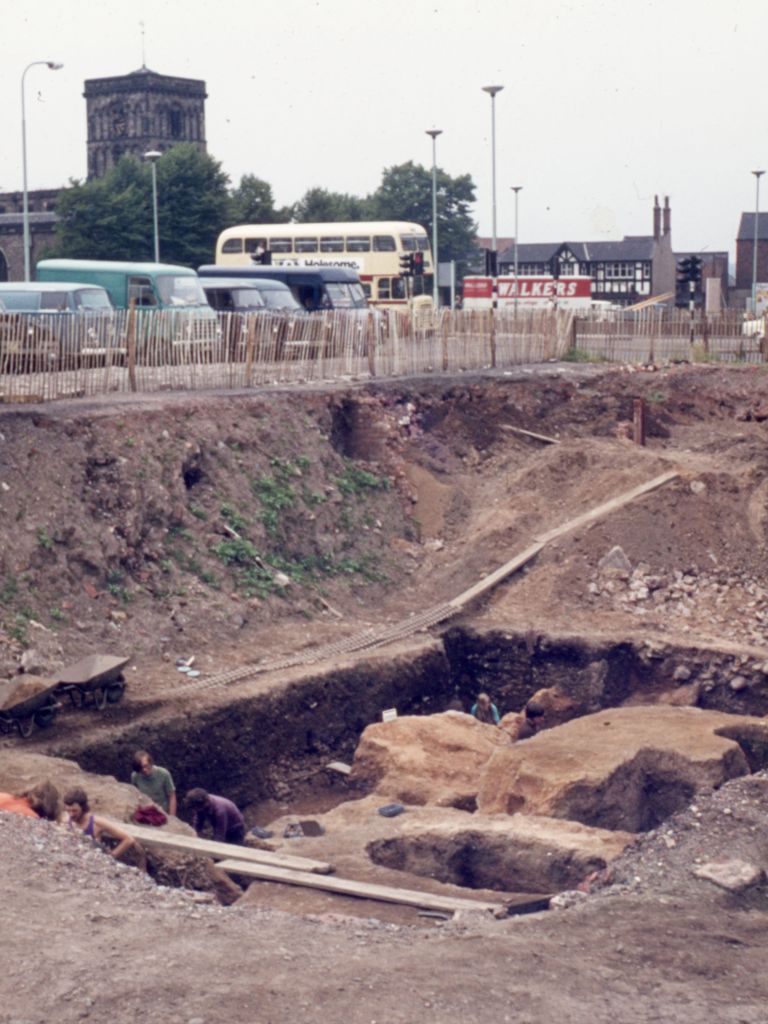
Despite some evidence from small excavations in the 1960s and 70s, we know very little about the forum’s internal appearance. It was evidently of high-quality construction, but most of the rooms were provided with plain clay or concrete floors, giving the impression of a very functional building. Some rooms were eventually redecorated with mosaic pavements and painted or marble-veneered walls and it is conceivable that traders were responsible for the upkeep and decoration of their own shops. Sadly, no direct evidence for the function of any of these shops has yet been discovered, but some had timber partitions which perhaps functioned as counters, whilst others contained small hearths which may have been for cooking food, providing warmth or for industrial purposes such as metalworking.
The area surrounding the forum contained a variety of public and private buildings. To the west was the Jewry Wall public bathhouse and Leicester’s only known Roman temple, a Mithraeum, whilst to the north commercial activity had expanded out of the forum into a macellum or market-hall. Evidence suggests the area surrounding the forum also contained smaller commercial and domestic properties. South of the forum, rows of timber shops initially lined the street; these were rebuilt in stone during the early 3rd century. To the east, further substantial stone buildings have been uncovered beneath what is now the BBC building on St Nicholas Place, whilst to the west was a large mid-2nd-century townhouse, now beneath St Nicholas Circle. This house contained the Peacock pavement, one of the finest mosaic floors discovered in Roman Britain.

Little is known of the forum’s final years, but repairs and renovations seem to have continued into the 4th century AD. Although evidence for a fire was found, damage was perhaps comparatively minor, as a new floor was laid in one of the affected rooms some time after AD 364 (based on the discovery of a coin of this date from beneath it).
The Public Baths

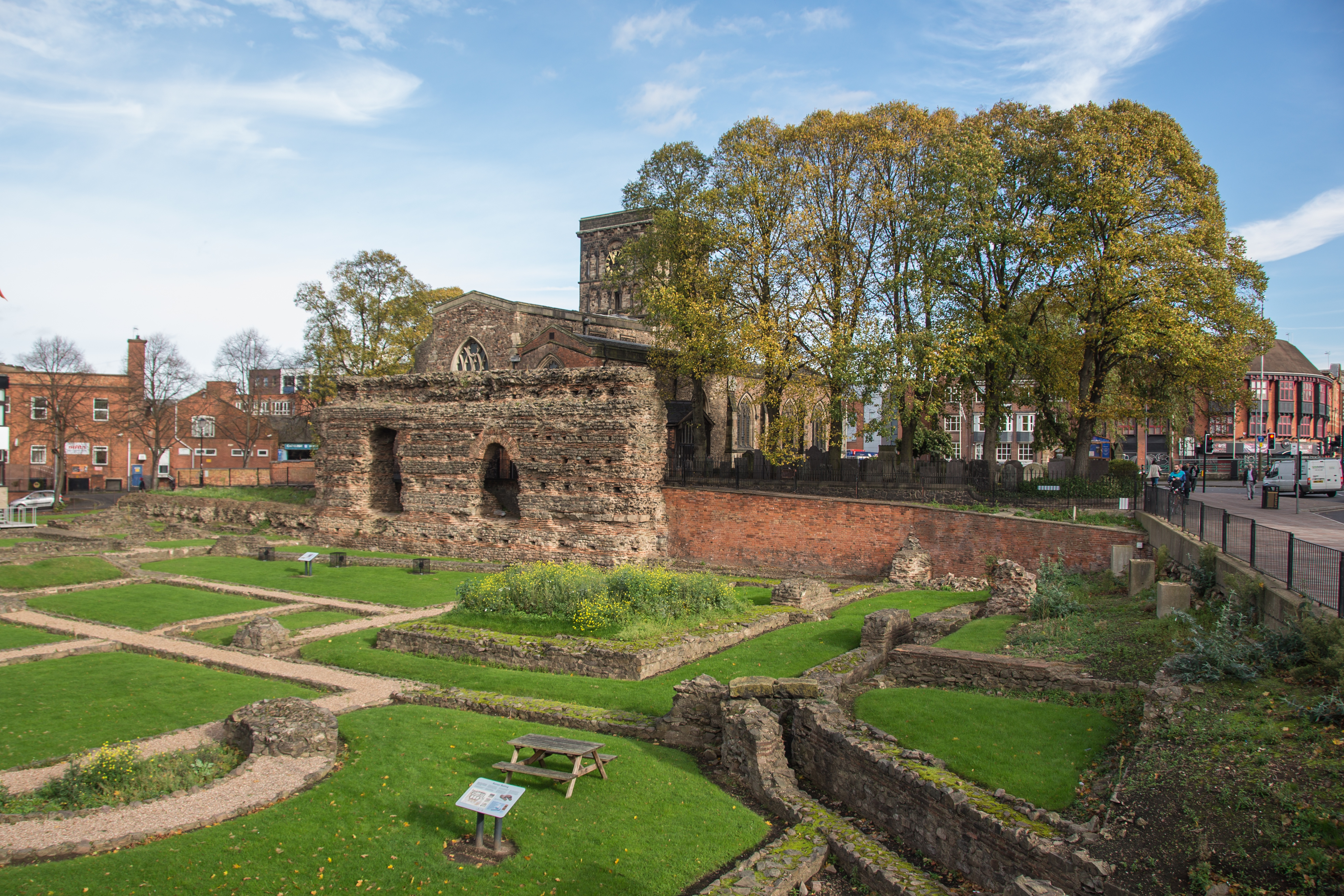
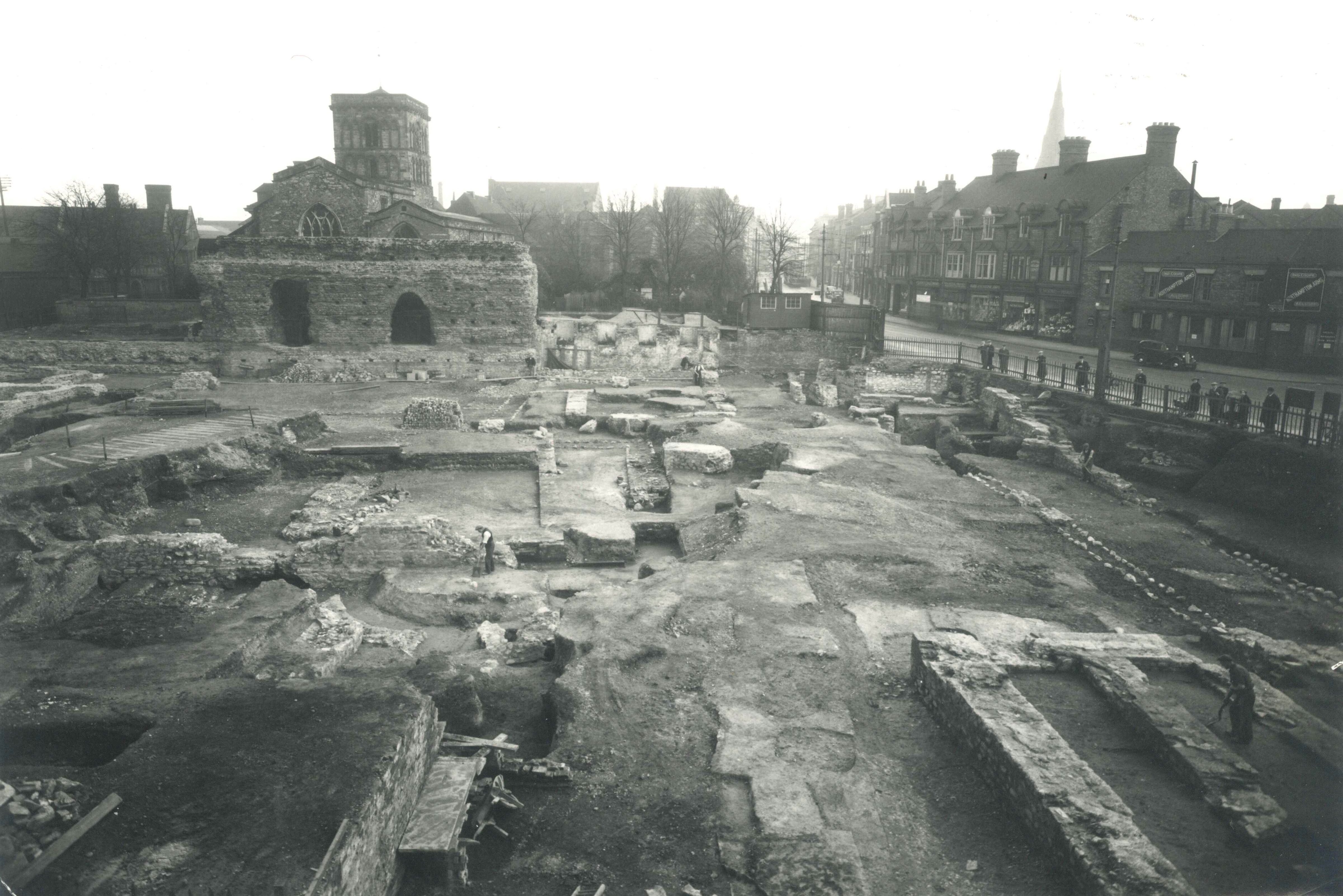
Today, the only visible reminder of Leicester’s Roman past is the Jewry Wall. At 23m long, 10.5m high and 2.5m thick, it is one of the largest pieces of civic Roman masonry still standing in Britain, comparable with the ‘Old Work’ at Wroxeter and the ‘Mint Wall’ at Lincoln. Since the medieval period, when it was commonly believed to be part of a temple to Janus, there has been much discussion about what the Jewry Wall may have been. It was not until it was excavated in the late 1930s by the pioneering archaeologist Dame Kathleen Kenyon (coincidentally in preparation for the building of a new swimming baths) that its role as part of a substantial bathing complex was demonstrated. Kenyon’s excavations were the first large-scale archaeological investigation of Roman Leicester and paved the way for over eighty years of archaeological discoveries.
Bathing was an integral part of cultural and social life in Roman towns regardless of who you were. Bath-houses were not just places to get clean: customers would also exercise, relax, eat, socialise and conduct business. They would now be considered similar to community centres, combining all the facilities provided by gyms, spas, libraries, shopping centres and restaurants.

Built in the mid 2nd century AD, the bath complex did not change much and probably remained in use until the 4th century AD. Access to the baths is thought to have been through arches in the Jewry Wall. This was the west wall of a large, aisled basilica on the eastern side of the complex, most of which now lies beneath the church of St Nicholas. This was the palaestra, the exercise hall where people could meet, box, wrestle and play ball games. The central focus of the baths themselves was the tepidarium, the warm room heated from under the floor through a hypocaust, where bathers could assemble and relax before moving on to the warm or cold baths. Here they would cover themselves with oils and use a tool called a strigil to scrape off the dirt and oil. On each side of the tepidarium was an apodyterium, a changing-room with latrines where belongings would be looked after by personal or hired slaves. The three hot rooms or caldaria were situated on the western side of the complex and would have been maintained at a temperature of about 40° C. They contained pools of hot water which was heated in tanks over furnaces fuelled from external stoke-rooms. This would have made the rooms very humid, much like a modern sauna. The final step was to plunge into a pool of cold water in the frigidarium, to close the pores and refresh the body.
 ROMAN LEICESTER