The pre-Roman settlement of Leicester was a southern centre of the Corieltauvi, a loose federation of peoples who controlled much of Leicestershire, Rutland, Lincolnshire and parts of Derbyshire, Nottinghamshire and Northamptonshire during the late Iron Age. The Romans later record its name as Ratae, a Celtic name meaning ‘ramparts’. Evidence from Leicestershire suggests that the Corieltauvi lived a largely rural life in farms and small village-like settlements. Ratae only developed at the end of the Iron Age, but quickly established extensive contacts with the rest of Britain and the Continent.
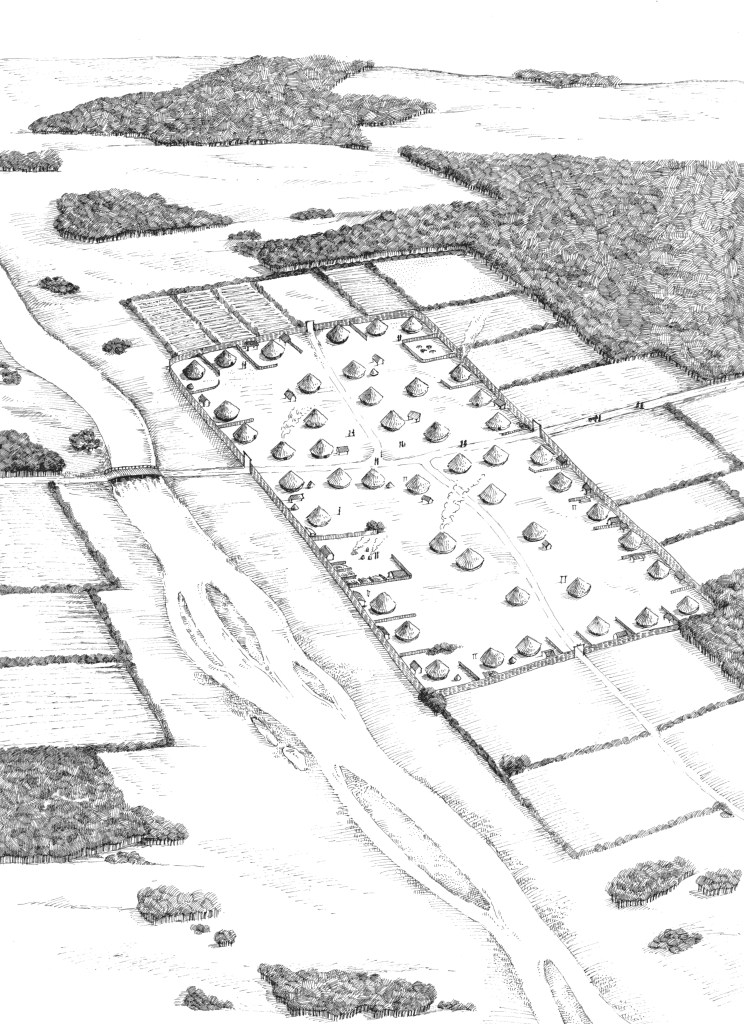
The first settlement (right) is thought to have been sited over a ten hectare area on the east bank of the River Soar near St Nicholas Circle in the modern city. The physical evidence largely consists of traces of roundhouses, pits, ditches and gullies, but the presence of high quality pottery and jewellery imported from Gaul (France), Italy and Spain together with Corieltauvi coins indicates that Ratae was a significant settlement of high status.
Another indication of Ratae’s importance is evidence for Iron Age coin production. This comes in the form of pieces of the clay trays (below) used to create coin blanks. Known as ‘flan trays’ these contain rows of small circular impressions of varying sizes, presumably representing different denominations of coin. Carefully measured portions of metal would have been placed in the holes, and the tray placed in a furnace for melting. The small globular pellets produced would then be hammered to a flat shape, and finally struck between two dies to produce the finished coin. Trays have been recovered from Bath Lane and show that the settlement was important enough to have a mint from the late 1st century BC.
Iron Age Leicester as it may have looked from the south during the early 1st century AD. Image: Sarah Greeves / ULAS


 ROMAN LEICESTER